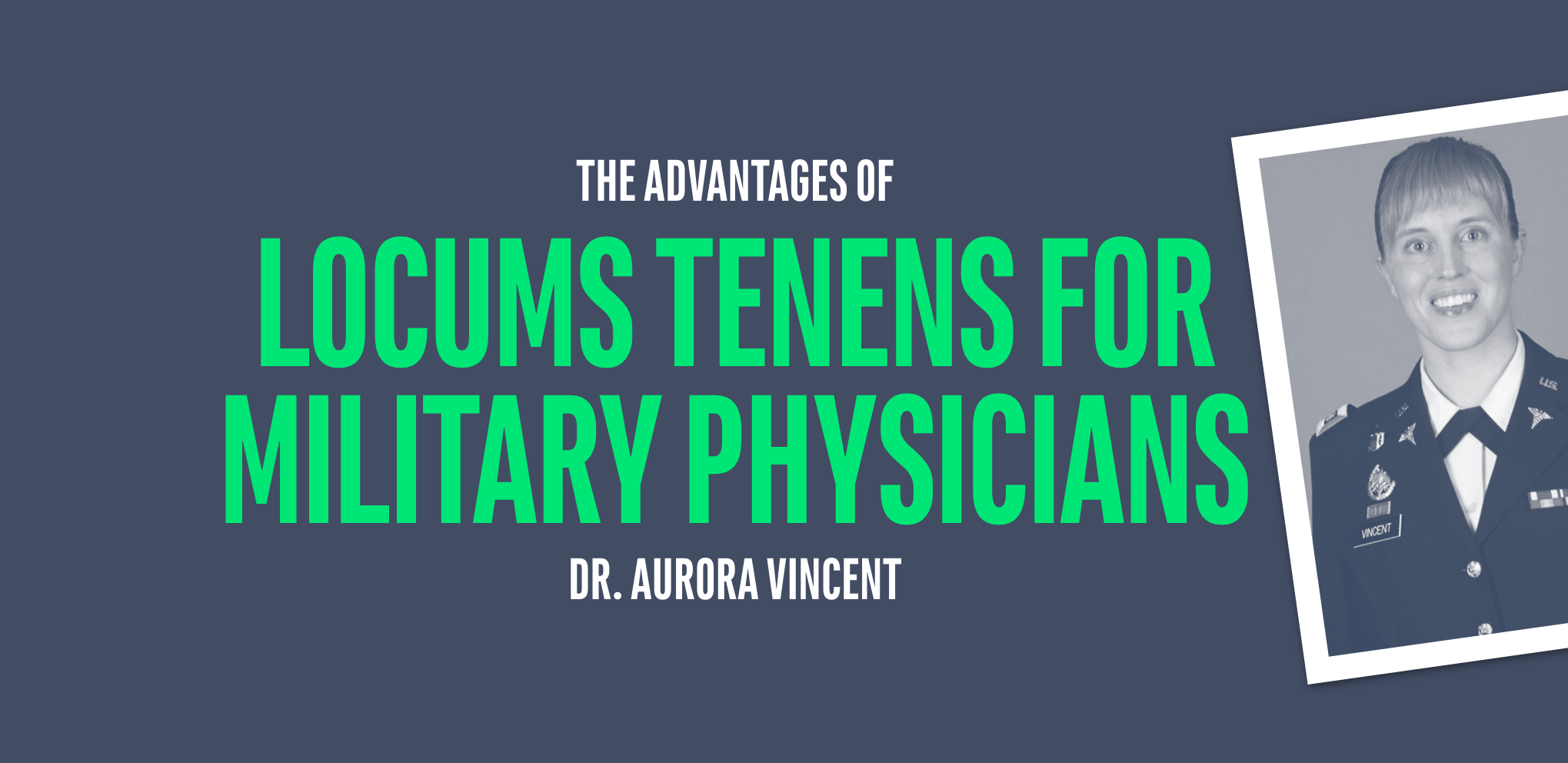
Locum tenens can be a great way for military physicians to expand their clinical expertise, earn extra income, and make connections in civilian medicine.
We spoke to one such physician ––Dr. Aurora Vincent, a head and neck surgeon (ENT) who serves in the U.S. Army––to learn more about how military medicine can differ from civilian medicine, and some of the unexpected advantages locums can offer to military physicians.
Here’s what she had to say:
When did you join the military, and what did that process look like?
I joined in 2009. After graduating from college, I applied to the Uniformed Services University, which is colloquially called the Military Medical School. Acceptance there comes with a direct commission, and when you apply you can rank list what branch you want to go into. I enlisted in the Army, so when I was accepted I was directly commissioned as a Lieutenant into the Army.
Technically, I was on active duty for the four years of medical school. It’s expected that you go to a military residency, and then you incur what is usually seven years of payback time after that as a staff physician.
You get the salary of a Lieutenant while you’re in school, and then the salary of a captain while you’re in residency. So certainly, you make more money as a medical student, and you’re paid more than traditional residents. The salary isn’t as much as a staff physician, but you don’t rack up medical school debts.
What went into the decision to join the military?
I don’t have a history with the military; neither of my parents served, though I had a grandfather, like many, who served in World War II. I think I just grew up watching a lot of M.A.S.H., and that piqued my interest in military medicine. [laughs]
In college, I got to shadow a former graduate from St. Olaf, who was also in the Army as a neurologist. He was at Walter Reed Medical Center at the time, which is where I learned about the Uniformed Services University, and ultimately that’s what led me to apply. It just seemed like a unique opportunity, and a neat way to start out with medicine.
How far into your military career did you start doing locums, and what did that process look like?
I did four years of medical school, five years of residency, and then two years of fellowship, which I just completed last summer. After I was assigned out at Fort Gordon I started looking into locums opportunities, mainly because I had built up a lot of leave that was going to become use or lose. I enjoy traveling to see family, but it was also nice to do other surgeries and make a little bit of extra money––that was part of the incentive.
Tell us more about the clinical side of your work––are there types of surgeries you perform through locum tenens that you don’t as a military physician, or vice versa?
Yeah, [my locums work] has been very unique and useful. The hospital where I’m stationed is great, but it’s a smaller Army medical center, so we don’t see many complex traumas.
Most often we see young, healthy, active duty folks, and their young, healthy families. Which is fine, but it limits the spectrum of pathology that you see. On the locums assignments that I’ve had, I’ve seen jaw fractures and orbit blowouts. My military colleague at also does locums, and he’s also seen a lot of trauma and some head and neck cancers that we don’t see on base, just because of its unique population.
Locums has given us the opportunity to keep up those skills and see different cases that we wouldn’t otherwise encounter.
Are there parts of your military training that you feel prepared you for locums?
I’d say it’s definitely prepared me for the locums lifestyle. In general, we’re very well-prepared [as military physicians], in part because a lot of military training has to do with what you’re going to do in a deployed setting, where you don’t have all the resources, staff, or instruments you normally have.
Certainly a locums setting is not a deployed setting. But you’re walking into a new clinic, where you don’t know how they do things, and you don’t know who the staff are, and you’re expected to operate in a clinic or an operating room with relatively little onboarding.
Having that experience of being able to navigate different ways of doing things, figuring out how to make do with what you have, makes walking into a locums environment fairly smooth and easy.
How has your locums work influenced your military career?
Locums is helping expand my view of medicine. When you come up in military medical school, and then military residency, and then go into military practice afterwards, it is kind of a closed community.
So it’s been useful seeing how things are done elsewhere. Because even though there are multiple military hospitals, they’re staffed by the same military surgeons, so in general things are run the same way. It’s interesting to see other practice models, other algorithms for working with patients, just different ways of doing things.
The adaptability we learn in the military helps us works in a locums environment, but the locums environment also helps us take new ways of doing things back to the military.
Are there other ways in which practicing both in the military and as a locums physician has expanded your clinical expertise?
A lot of it is just the variability of the patient population. I see a lot of patients [through my locums work] that are frankly older than the population I see at the military hospital. Also, in different regions of the US, you see different things. There was a woman out in Montana who had been trampled by a steer. We don’t see that on base. You just see entirely different types of pathology.
[You also see the] variability in how things are done: how the clinic is run, their staff makeup, different kinds of scopes, microscopes, and equipment. A lot of that will be very useful in the future as I’m looking at retiring from the military and seeking a job on the outside, because I won’t have had any other experience on the civilian side.
Locums can help you make some connections––networking is important––but it can also help you figure out what you actually want to do: how you want to run a practice, what are the right questions to ask.
What are some of the other advantages of doing locums while you’re on active duty?
Other than meeting new practices and new folks, it also helps with academic promotion, if you have an active academic career in medicine. When you apply for a promotion as an assistant professor or associate professor, you have to have letters of recommendation from people who are not at your institution. And in the military, every institution is considered the same. So through my locums work, I’ve met doctors who I can reach out to for that type of letter. That kind of networking otherwise only happens at conferences, which are once a year, so that’s also a benefit.
Also, I just enjoy traveling. Even though you are working, for me it’s also kind of a vacation to get away from where I am every day, come out to someplace new, experience new scenery and new people.
What advice would you give to other military doctors who might be considering locums work? Are there things you wish you knew when you were starting out?
I’ve been lucky, and have had great experiences so far. I was surprised to learn about the vast array of opportunities. I figured that most places would just be general ENT, wanting help in clinic, that type of thing. But really, I’ve been operating a decent amount, I’ve seen a lot of trauma. There are a lot of opportunities, not just for one or two week or weekend calls, at trauma or non-trauma hospitals––there’s really the full breadth of opportunity for anything you’re interested in.
I would tell anyone considering locums to keep an open mind. Even if an assignment seems like a dud, like it’s just clinic for a week, there’s still a lot to learn, and a lot that you can take back to your practice.
*This interview has been edited for clarity and length.